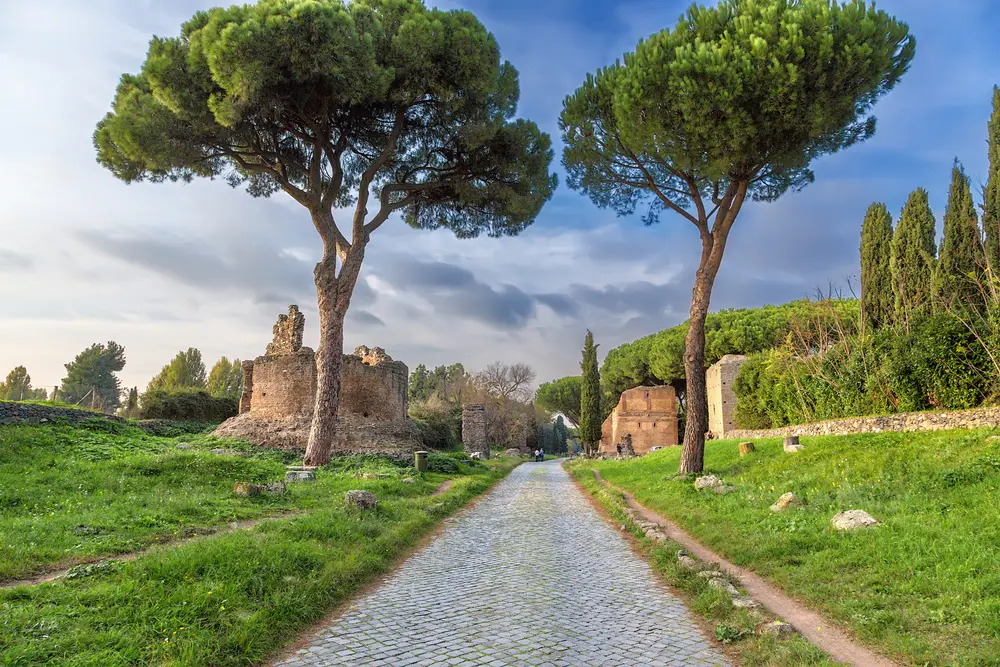
Known in ancient times as the Regina Viarum, or Queen of Roads, the Appian Way was one of the most important roads built by the Romans. Today, walking or cycling along its ancient stones offers a completely different perspective on the Eternal City. Instead of moving from one monument to another, you follow a road that has connected people, armies, merchants and travelers for more than two thousand years.
If you want to discover Ancient Rome beyond the Colosseum and Roman Forum, the Appian Way is one of the most fascinating routes to explore.
What is the Appian Way?
The Appian Way was constructed at the end of the 4th century BC, initially connecting Rome with Capua in southern Italy. Over time, the road was extended towards Brindisi, an important port that linked Italy with Greece and the eastern Mediterranean.
Its importance was enormous. The road allowed Roman armies to move efficiently across the peninsula, supported trade and connected Rome with territories farther south. Its construction also demonstrated the extraordinary engineering skills of the Romans.
Much of the original road has disappeared beneath modern development, but significant sections of the Via Appia Antica in Rome remain remarkably well preserved. The ancient basalt paving stones, known as basoli, are still visible beneath your feet, sometimes marked by traces left by ancient carts.
Walking here is therefore more than a simple sightseeing experience. The road itself is the monument.
Why is the Appian Way important?
The Appian Way is important because it represents much more than an ancient route between two cities. It was a fundamental part of the Roman world and remained relevant for centuries after the height of the Empire.
The road was surrounded by tombs, villas, mausoleums, temples and other monuments, particularly outside the city walls. Roman law generally restricted burials within the city, so major roads became places where wealthy families built impressive funerary monuments.
This explains one of the most distinctive features of the Appian Way today: as you walk through the countryside, ancient tombs and ruins appear alongside the road, sometimes unexpectedly.
The setting makes the experience particularly evocative. Rome’s ancient past and its rural landscape meet along the same path, creating a scene that feels remarkably distant from the busy streets of the city center.
Where does the Appian Way start?
The ancient Appian Way originally began near Porta Capena, close to the Circus Maximus, before heading south from Rome.
The modern experience of the Appian Way usually begins farther outside the historic center, around Porta San Sebastiano and Via Appia Antica. From here, the route gradually leaves the urban landscape behind.
One of the most interesting things about exploring the Appian Way is this transition. Within a relatively short distance, the noise and density of central Rome give way to pine trees, open fields, archaeological remains and long stretches of ancient road.
The Appian Way archaeological park extends well beyond the section closest to the city, incorporating other remarkable areas such as the Caffarella Valley and the Aqueducts. This makes it possible to spend anything from a few hours to an entire day exploring the area.
What to see along the Appian Way
There is no single monument that defines the Appian Way. Instead, its appeal comes from the succession of archaeological sites that line the ancient road.
Porta San Sebastiano
A natural starting point is Porta San Sebastiano, one of the best-preserved gates of Rome’s Aurelian Walls. It marks the point where the urban city begins to give way to the ancient road.
From here, you can follow the route south and gradually enter the landscape of the Appian Way.
Domine Quo Vadis
A little farther along stands the small Church of Domine Quo Vadis, associated with the Christian tradition surrounding Saint Peter.
According to legend, Peter was attempting to leave Rome when he encountered Christ on the road. The apostle asked, “Lord, where are you going?” — Domine, quo vadis? — and the encounter supposedly convinced him to return to Rome.
Whether you approach the story as history, tradition or legend, the location adds another layer to the extraordinary history of the road.
The Catacombs of San Callisto
The Catacombs of San Callisto are among the most significant early Christian burial complexes in Rome. Their underground galleries preserve centuries of Christian history and offer a glimpse into a very different period of the city’s past.
The catacombs are one of the reasons the Appian Way is such a rewarding destination for anyone interested in Ancient Rome and early Christianity. Above ground, you can follow the road used by Romans; underground, you encounter the communities that lived and worshipped in the centuries that followed.
The Catacombs of San Sebastiano
Another important site is the Catacombs of San Sebastiano, located beneath the Basilica of San Sebastiano.
The complex combines archaeological remains, religious history and ancient funerary traditions, making it another fascinating stop along the route.
The Circus of Maxentius
Further along the road, the Villa of Maxentius reveals the scale of imperial Rome. The complex included a monumental villa, a circus and a mausoleum.
The Circus of Maxentius is particularly striking because its remains are still integrated into the open landscape. Standing beside the ancient road and looking towards the ruins gives you a sense of how expansive the imperial complexes outside Rome could be.
The Tomb of Cecilia Metella
One of the most recognizable landmarks on the Appian Way is the Mausoleum of Cecilia Metella, a monumental cylindrical tomb dating from the late 1st century BC.
Its imposing structure has become an emblem of the Via Appia Antica. Nearby, medieval additions show how the site continued to evolve long after the Roman period.
For many visitors, reaching Cecilia Metella marks one of the most memorable moments of an Appian Way walk.
Can you walk the Appian Way?
Yes, and walking the Appian Way in Rome is one of the best ways to appreciate its atmosphere.
The route combines ancient paving stones, archaeological monuments and countryside, but it is important to remember that the surface is uneven in several sections. Comfortable shoes are therefore essential.
The first part of the route can also have traffic, while farther along the ancient road the atmosphere becomes considerably quieter. On Sundays and public holidays, restrictions on private traffic can make the experience particularly pleasant.
If you want to explore beyond the first monuments, however, cycling the Appian Way can be a better option. A bicycle allows you to cover more ground without losing the feeling of being immersed in the landscape.
Is the Appian Way worth visiting?
Absolutely, especially if you have already seen Rome’s most famous landmarks and want to discover another side of the city.
The Appian Way offers something that many central Roman attractions cannot: space, silence and a direct connection with the landscape of antiquity.
You are not simply looking at ruins behind barriers. You are moving along the same route that existed in the ancient world, surrounded by monuments that have witnessed centuries of change.
It is also a wonderful choice if you are interested in photography, archaeology, Roman history or simply want to spend a few hours outdoors.
For travelers who want to experience Rome at a slower pace, the Appian Way provides a striking contrast with the energy of the city center.
Walking or cycling the Appian Way?
Both options have their advantages.
Walking allows you to slow down and pay attention to details: inscriptions, paving stones, fragments of ancient structures and the changing landscape. It is ideal if you want to focus on the history of the Appian Way and explore individual monuments along the route.
Cycling, on the other hand, allows you to experience a longer section of the ancient road. You can move from the city towards the Roman countryside, passing villas, tombs, archaeological sites and stretches of original paving.
A guided cycling experience can make the journey even more meaningful. Instead of simply passing the ruins, you can understand the stories behind them and discover places that are easy to overlook when exploring independently.
How long does it take to visit the Appian Way?
There is no single answer because the Appian Way is much more than one short attraction.
A visit focused on the section around the major archaeological sites can take a few hours. If you want to explore a longer stretch, visit the catacombs and stop at several monuments, you can easily dedicate half a day to the experience.
Cycling is particularly useful if you want to see more of the Appian Way in limited time. The route can be adapted according to your pace, interests and the amount of time you have available.
The most important thing is not to treat the Appian Way as a checklist of monuments. Give yourself time to enjoy the road itself.
The Appian Way: a different way to experience Rome
The beauty of the Appian Way lies in the contrast. You are still in Rome, yet the atmosphere feels far removed from the crowds around the Trevi Fountain or Piazza Navona.
Ancient stones lead through a landscape of cypress and pine trees. Tombs rise beside the road. Roman villas emerge from the countryside. Beneath the ground, catacombs preserve stories from the early Christian era.
Few places in Rome allow you to experience so many layers of history within a single journey.
And perhaps that is what makes the Appian Way so special. It does not simply show you the remains of Ancient Rome. It allows you to follow its path.
Experience the Appian Way with Italy’s Best Rome
If you want to go beyond simply visiting the Appian Way and experience it as part of a private, carefully tailored journey through Rome’s hidden past, Italy’s Best Rome offers a half-day cycling experience along the ancient road.
You can ride across original Roman cobblestones, discover ancient villas and mausoleums, explore the area around the Circus of Maxentius and enjoy an exclusive visit to an ancient catacomb. The itinerary can also be adapted to your pace, interests and available time, with e-bikes available on request.
For a more personal way to discover one of Rome’s most fascinating archaeological landscapes, book the Cycle the Appian Way experience with Italy’s Best Rome and experience the Queen of Roads beyond the usual tourist itinerary.